

Ground Truth 01
The Deployment: Where Code Meets the Mission
We’re exploring the intersection of elite engineering and the defense mission. In this series, we talk to the people navigating the gap between commercial tech and the field.
Real-world software doesn’t live in clean environments. At Onebrief, we build for the rigors of the field. Solving for these realities requires a team that can connect high-end engineering with the actual conditions of the mission.
We bridge that connection through a mix of experts: from Big Tech veterans to those who have spent years in uniform. We work as one team, combining technical excellence with a firsthand understanding of the environments we serve. It’s a collaboration where every perspective is essential to building software that survives the real world.
We sat down with Steve Clement and Lucas Ramage to discuss the "3D world" of defense tech, where the ultimate test isn't a server crash—it’s a changing battlefield.
Meet the Experts
Steve Clement | Technical Delivery Manager
Steve joined Onebrief in 2024, initially serving as the Operations Manager for the U.S. Space Command account. He brings deep operational experience from his time as a full-time Infantry Officer with the 4th Infantry Division and currently serves as the Commander of the 217th Space Company, Colorado Army National Guard. At Onebrief, Steve acts as the bridge between the customer and the product, translating mission signals into technical requirements. He works closely with our clients to navigate the complexities of hardware infrastructure and ensure that Onebrief is deployed on the most resilient, high-performance environments available.
Lucas Ramage | Enterprise Solutions Architect
Lucas joined Onebrief in 2025 and leads a specialized team of solutions engineers and architects focused on infrastructure and compliance. With a career rooted in "Big Four" consulting and major contributions to the open-source community—including the Linux kernel and Kubernetes—he brings elite commercial engineering standards to the defense sector. At Onebrief, Lucas oversees the resilient, secure architecture required to deploy mission-critical software into highly classified customer environments.
Editor’s Note: This interview has been edited for length and clarity. You can watch the full conversation on YouTube here.
The Reality of the Field
In this industry, there can be a gap between building a product and seeing it actually work in the field. What is it about the way we deploy and deliver here that allows you to see a more direct, real-world impact?
Lucas: I’d have to say it’s our attention to detail on that “last mile” of delivery. Every software company has CI/CD pipelines and cloud deployments, but we are coordinating updates across different classified environments and keeping them all in sync. Because we ship things weekly, that gap between building and field-testing essentially disappears. That’s really a testament to the talent we have on our team.
Steve, you’ve seen the gap between what the frontline needs and what tech can actually do. How does having elite commercial engineers on the team change our approach to hard deployment problems?
Steve: It’s great that we have such a diverse set of backgrounds on our team that can bring best practices out of industry and help bring it to customers that sometimes take longer to field new technologies because they’re wed to the processes of government agencies.
It gives us the ability to show the destination we’re moving toward and communicate more meaningfully with our customers about the added value they gain from changing a business practice around a new piece of technology. That’s way easier to do when we have people on our team who have seen that same type of work done in the commercial space. That’s where having someone like Lucas is huge; his depth of expertise has been invaluable in helping our customers understand what it is that we’re trying to do when we pitch them a particular solution.
In the commercial world, success is business uptime. Here, the end user is a Commander in a high-stakes environment. How does knowing those stakes change the way you build “zero-fail” infrastructure?
Lucas: My whole career I've been supporting critical infrastructure, especially through open-source projects. I’ve done contributions to the Linux kernel, Kubernetes, and the Grafana stack we use here. I’m very familiar with the deep layers that live underneath the software that powers the internet today.
In the Big Four, I saw the impact in terms of business revenue, but most companies there are striving for essentially "five nines" of uptime. The worst thing they usually account for is the server gets unplugged or there’s a power failure. Whereas here, the server might not exist tomorrow.
When we talk about redundancy and resiliency, our disaster recovery planning accounts for that. We look at backups almost on a daily basis to make sure that we have redundant copies of customer data distributed so that we're able to do a restore at any given point—which we’ve done.
Steve: That’s an area where Lucas and I have had a decent amount of fun bouncing ideas off one another: What is the right amount of resiliency and redundancy for the customer’s real requirements? We want to deliver those advanced capabilities and "five nines" of availability, but it’s an entirely different environment if someone is going to be shooting back at you. We have to help the customer accurately prioritize their own resources, and our own, so we’re building what is most valuable to them. That is the crux of it: bringing that blend of commercial creativity and applying it to create meaningful solutions.
"Most companies strive for ‘five nines’ of uptime. Here, the server might not exist tomorrow." — Lucas Ramage
Can you describe the “translation” process? How do you take a raw mission requirement and turn it into a high-functioning technical capability?
Lucas: Honestly, that’s pretty much what we do daily and weekly—that really is the heart of the mission for us. Enterprise architecture is just a big phrase to describe aligning people, process, and technology in a way that makes sense from a business perspective. I can look at a problem and see six different ways to solve it with technology, and then have someone like Steve jump in and explain the ways the customer has implemented their processes.
A lot of what we do is very time-sensitive. In a normal consulting engagement, you have a start, an end, and a certain amount of dollars to execute a project and call it done. But our customer base needs timely, dynamic, and responsive solutions. This might be the best approach on paper from a software perspective, but other times we go with approaches that are really what the customer is asking for and needing, and we figure out how to work back from there.
We have a unique mix here of people who served in uniform and people who built their careers in the tech sector. Why do you think this specific partnership is so critical to the work we’re doing right now?
Steve: I know there’s a limit to my technical depth. I rely on Lucas's expertise to help bridge that gap: taking what the customer says they want, based on the lens I bring from my own experience, and figuring out how that actually gets us to a meaningful solution. We’ve fought through challenges where we have an awesome solution, but it’s reliant on a commercial cloud technology that has limited availability on air-gapped, classified networks. Helping the organization understand those hardware limitations and laying out a path to find additional resources is where we deliver effectively.
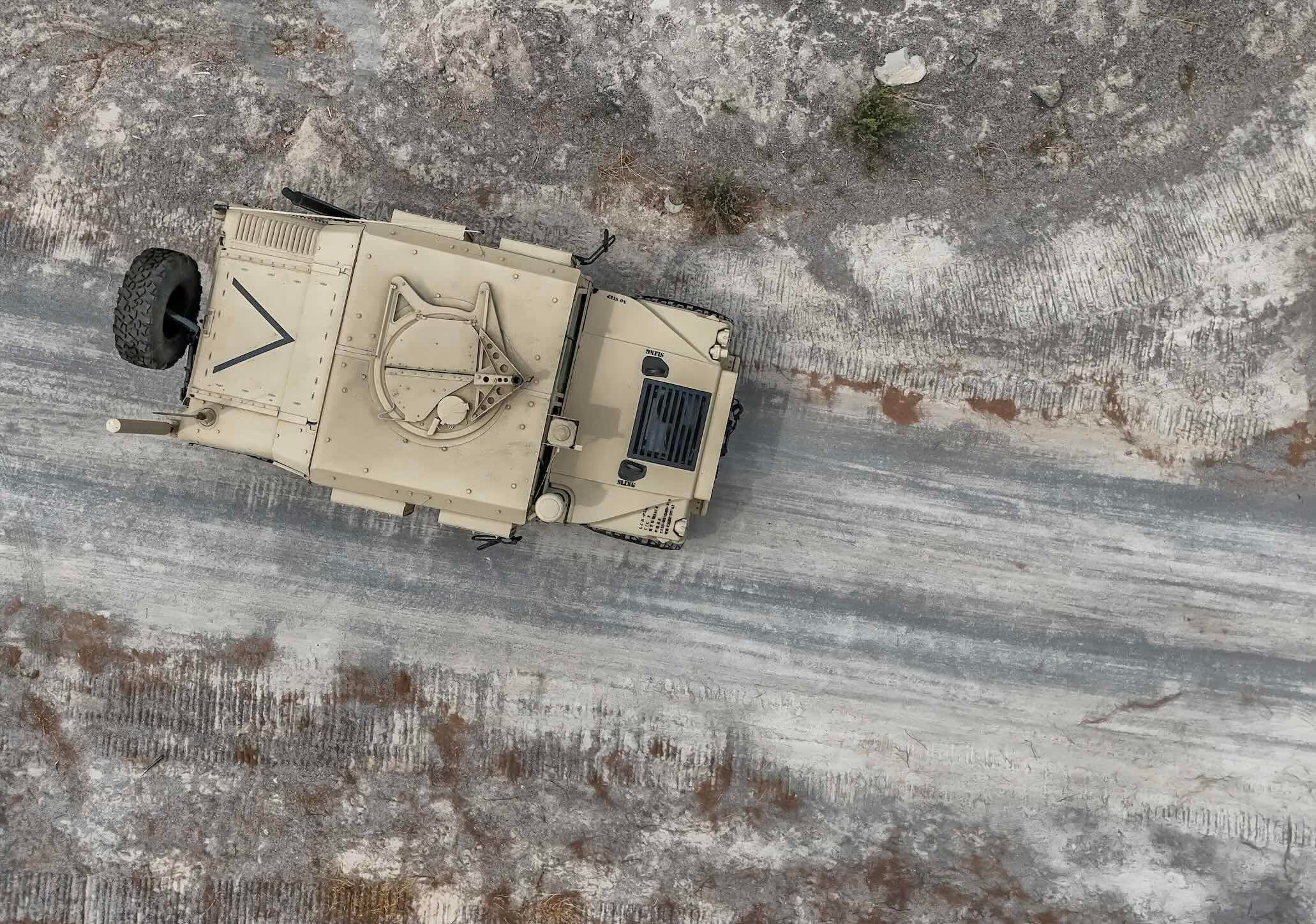
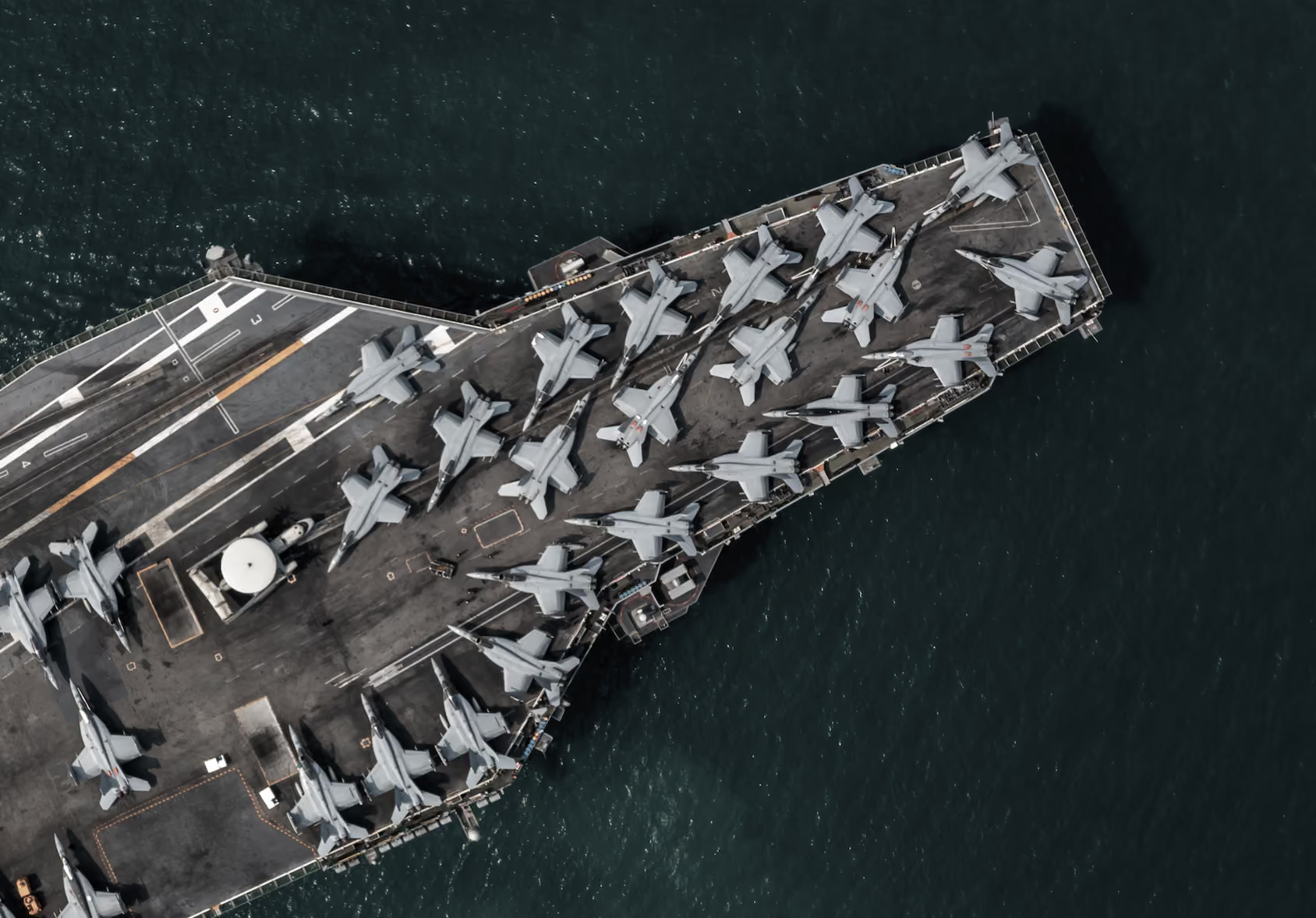
Lucas: Most startups I've worked in struggle with truly engaging the customer. At Onebrief, I am shoulder-to-shoulder with customers all the time. It’s one thing to build something that lives on a server, but how do you run that on a ship? How do you run that out of the back of a truck? Understanding that our software lives in a 3D world alongside humans in the field really helps shape how we solve the people problems using the technology that we have today.
Moving past the technical specs, how does the mix of veteran and non-veteran perspectives shape our day-to-day culture and problem-solving?
Lucas: I’m a very academic person by nature, but being around the discipline of our veteran team members—seeing them hit the gym at 0400 regardless of the time zone—really pushes me to a higher standard. Our company is full of people who don’t just say values; they show them. That is a powerful combination when you’re building infrastructure that has to support users in the most severe environments.
Steve: The partnership here goes both ways. I never thought I would know nearly as much as I know now about cloud computing and the way that you take applications like ours to scale. It’s been remarkable getting the opportunity to learn things every day from Lucas.
Any final thoughts on why this mission matters and what you'd say to those looking at this industry?
Steve: As someone who still wears the uniform part-time, I have to say: Go Army! If there’s an 18-year-old kid watching this who wants to sit in either of these shoes one day, I'd tell them that this has been a remarkable journey. It’s done amazing things for my family and opened up incredible opportunities for me. Choose to serve for a while, regardless of whether you choose to do five years or twenty, the doors it opens are just incredible. You never know where you're gonna wind up. I’m incredibly blessed to be standing where I am today and getting to talk with a friend of mine like Lucas.
Lucas: While I was never in uniform, I come from a very strong military heritage—three generations and most of my siblings. This is truly important work, and it’s personal to me. To anybody working in technology: there’s a human element here. If you’re just watching a monitor or you’re on call doing the regular tech things, yes, it’s important and stressful—but here, there’s another layer to it considering the people we’re supporting. If you want to get into this type of work, just make sure you're doing it for the right reasons, because it will change lives.
The Mission Perspective
From ensuring a Commander has a working map in a dead zone to securing data across classified networks, the goal at Onebrief remains the same: delivering technology that works where it’s needed most. As Steve and Lucas’s partnership shows, solving these challenges requires more than just technical specs or military experience alone. It takes a shared commitment to the “Ground Truth” of the mission.
Up Next

Copyright © 2026 Onebrief.
ALL RIGHTS RESERVED.